
Used Car CIF Insurance Explained: 5 Reasons Why FOB Is Often Safer
What Used Car CIF and FOB Mean in Simple Terms
- FOB (Free On Board):
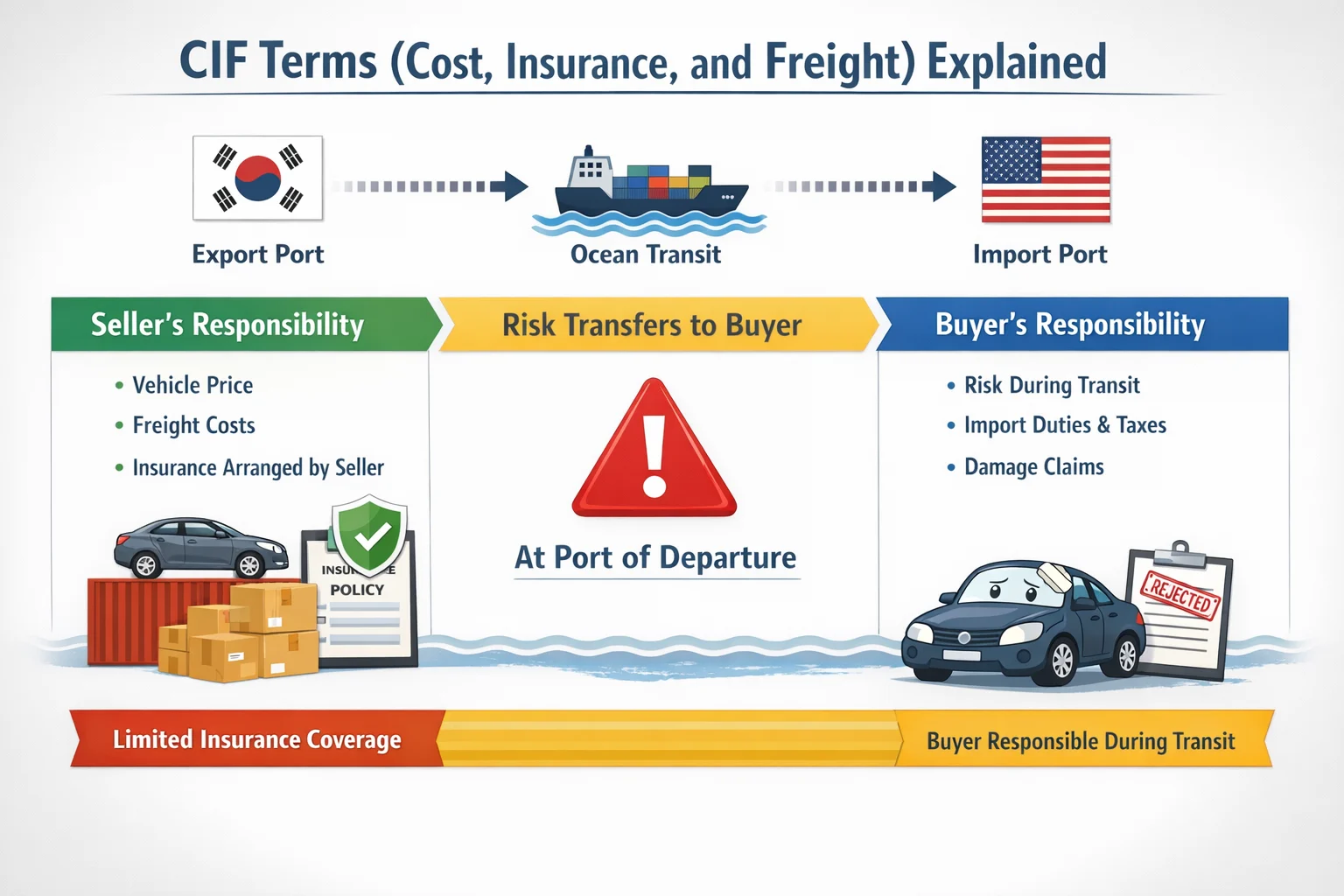
The seller’s responsibility ends once the vehicle is loaded onto the vessel at the port of departure. - CIF (Cost, Insurance, and Freight):
The seller arranges freight and insurance, but risk still transfers to the buyer once the vehicle is on board. These distinction is critical and often misunderstood.
CIF vs FOB: Responsibility Comparison Table
| Item | FOB | CIF |
|---|---|---|
| Export clearance | Seller | Seller |
| Loading on vessel | Seller | Seller |
| Sea freight | Buyer | Seller |
| Insurance | Buyer | Seller (minimum only) |
| Risk transfer point | On board vessel | On board vessel |
| Import clearance | Buyer | Buyer |
| Damage disputes | Fewer | More common |
Used Car CIF Insurance Explained: What Buyers Should Really Know
Many overseas buyers importing vehicles from Korea believe that CIF shipping is impossible because used cars cannot be insured. This assumption is incorrect. Used car CIF insurance does exist, but the coverage is often far more limited than buyers expect, which is why CIF is rarely used in real export practice.
Can Used Cars Be Insured Under CIF?
Used vehicles can be covered by marine cargo insurance, not road or comprehensive car insurance. Marine insurance applies to risks during sea transport and can include used cars, especially when they are shipped in containers. In principle, this allows used car CIF insurance to be arranged.
However, insurance companies treat used vehicles as higher-risk cargo. Existing wear, prior damage, and unknown mechanical conditions make risk assessment more complex. As a result, policies often include exclusions, higher deductibles, or restricted claim conditions.
Why Used Car CIF Insurance Is Limited in Practice
The main challenge with used car CIF insurance is not legality, but practicality. For RoRo shipping, most insurance policies cover only total loss events such as sinking or fire. Minor damage — including scratches, dents, broken mirrors, or interior issues — is usually excluded.
Because it is difficult to prove when and where damage occurred during loading or unloading, insurance claims frequently lead to disputes. In many cases, CIF creates a false sense of protection rather than real security for buyers.
Why FOB Is the Preferred Option
Due to these limitations, FOB (Free On Board) has become the industry standard for used car exports. Under FOB terms, the seller’s responsibility ends once the vehicle is loaded. Buyers arrange insurance locally, where claim handling is clearer and coverage can better match local regulations. This structure reduces misunderstandings, limits liability, and keeps pricing transparent for both exporters and buyers.
When CIF Can Still Be Considered
Used car CIF insurance may be possible in limited cases, mainly for container shipments with clearly defined insurance terms. Even then, buyers should understand that full coverage is not guaranteed and exclusions must be confirmed in advance.
CIF = CFR (cost+freight)+ Insurance
Risk transfers at the same point (on board the ship), but cost responsibility differs CIF is more convenient for buyers who don’t want to handle insurance CFR is preferred when buyers want control over insurance terms
Final Advice for Buyers
Used cars are not excluded from insurance, but used car CIF insurance should not be mistaken for full protection. For smoother and dispute-free transactions, FOB remains the safest and most widely accepted option in the used car export business. For used car imports:
- FOB is safer and clearer in most cases
- CIF should be used only when insurance terms are fully understood and documented
- Responsibility does not equal convenience — clarity is more important
Understanding CIF and FOB responsibilities helps buyers avoid disputes, unexpected losses, and broken business relationships.
Based on real export practices in Korea, where FOB is commonly used to minimize insurance-related disputes.
Updated: Dec. 16, 2025