The Future of Electric Vehicles: 7 Key Trends, Big Challenges & What Must Change
🌐 Global EV Market Share in 2024
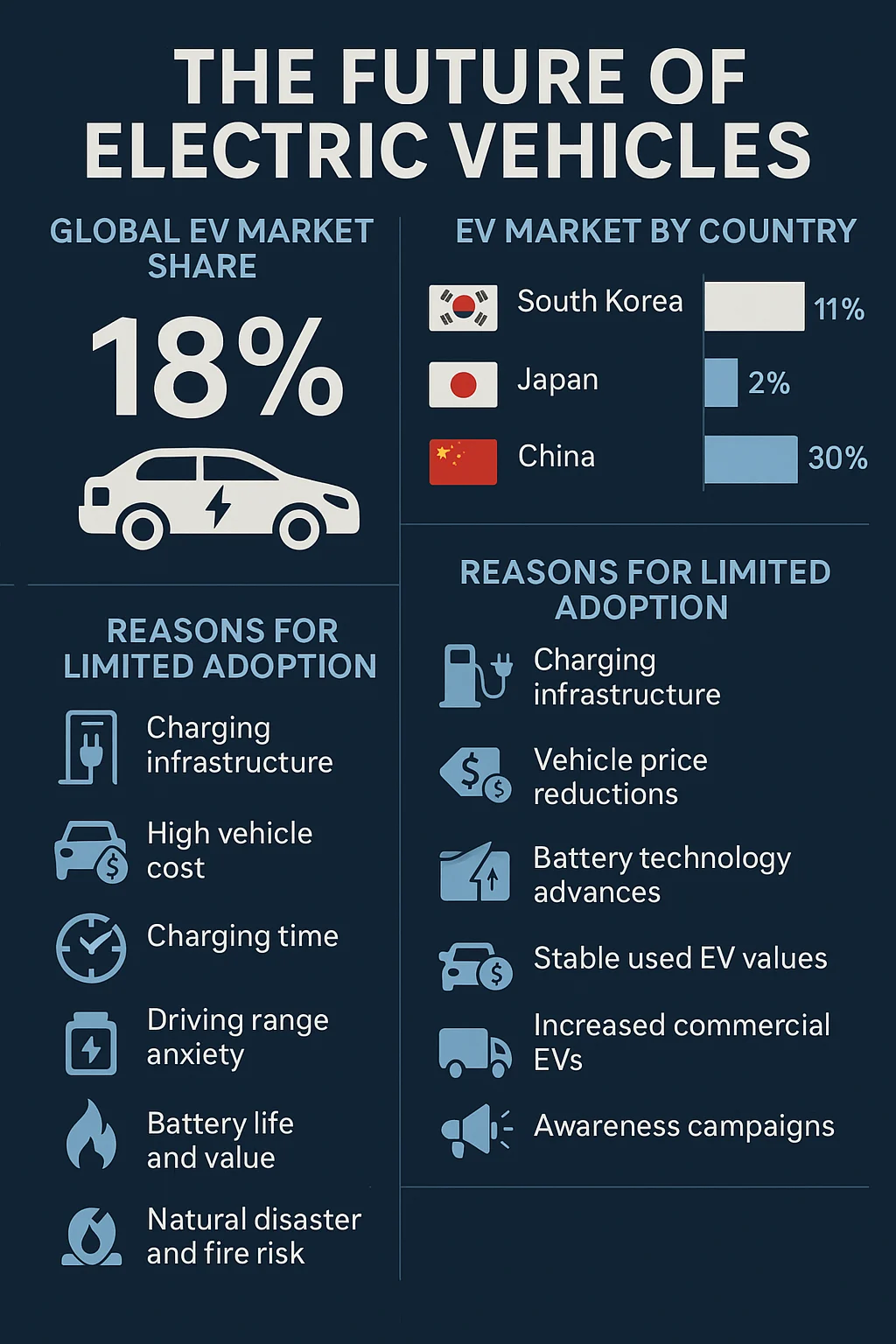
Electric vehicles (EVs) are rapidly transforming the automotive industry. As of 2024, EVs account for approximately 18% of new vehicle sales worldwide. However, when looking at total registered vehicles on the road, EVs still represent only about 3–4%, showing that widespread adoption is still in its early stages. ( In 2023, more than 14 million electric cars were sold globally, representing 18% of all new car sales. )
Source: International Energy Agency (IEA), Global EV Outlook 2024, Published April 2024
📎 https://www.iea.org/reports/global-ev-outlook-2024
📊 EV Adoption by Country
🇨🇳 China: Leading the Global EV Market
- Electric Vehicles share: 30% of new vehicles
- Key brands: BYD, NIO, XPeng, Tesla (China)
- Strengths: Massive government incentives, battery production dominance (CATL), and affordable EV options
🇰🇷 South Korea: Rapid Growth but Limited by Infrastructure
- Electric Vehicles share: 11% of new cars sold in 2024
- Popular models: Hyundai Ioniq 5, Kia EV6, Genesis GV60
- Challenges: Lack of charging stations in apartments, resale value concerns, limited rural infrastructure
Here is the table summarizing South Korean electric vehicles (EV) manufacturers, model years, vehicle types, and key features:
| Manufacturer | Model | Release Year | Vehicle Class | Key Features |
|---|---|---|---|---|
| Hyundai | Ioniq 5 | 2021 | Mid-size CUV | E-GMP platform, 800V ultra-fast charging |
| Hyundai | Ioniq 6 | 2022 | Mid-size sedan | Aerodynamic design, extended range |
| Hyundai | Kona Electric | 2018 | Subcompact SUV | Budget-friendly, optimized for city driving |
| Kia | EV6 | 2021 | Mid-size CUV | Sporty design, optional AWD |
| Kia | EV9 | 2023 | Full-size SUV | 3-row seating, large family EV |
| Kia | Niro EV | 2018 | Subcompact SUV | Available in hybrid and EV versions |
| Genesis | GV60 | 2021 | Premium CUV | Luxury interior, facial recognition tech |
| Renault Korea | Zoe | 2020 | Compact hatchback | French design, ideal for urban mobility |
| KG Mobility | Torres EVX | 2023 | Mid-size SUV | First EV conversion of domestic mid-size SUV |
🇯🇵 Japan: Lagging Behind
- Electric Vehicles share: Less than 3%
- Reason: Strong reliance on hybrids (HEVs), late shift toward full EVs by companies like Toyota and Honda
- Government support: Comparatively weaker than other nations
⚠️ Why Electric Vehicles Aren’t Fully Mainstream Yet
Despite the EV revolution, several key factors prevent electric vehicles from becoming a global norm:
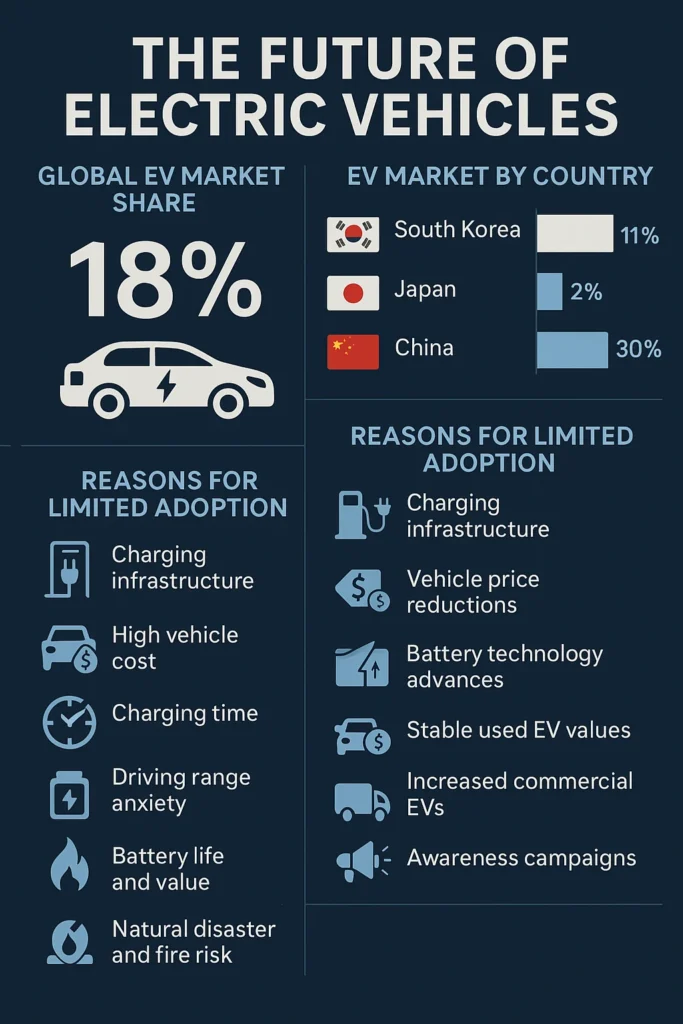
- Charging Infrastructure Gaps
EV charging is still inconvenient in many cities and nearly impossible in some rural or apartment-heavy areas. - High Initial Vehicle Costs
Even with subsidies, EVs tend to be pricier than gas-powered cars. - Long Charging Times
Fast chargers still take 30–60 minutes, which is much longer than fueling at a gas station. - Range Anxiety
Drivers worry about running out of charge—especially during cold weather or long highway drives. - Battery Value & Life Uncertainty
Concerns over degradation and replacement costs hinder resale trust and second-hand EV markets. - Fire Risks & Disaster Safety
Although rare, EV fires are harder to extinguish. Some users fear the implications during accidents or floods.
🔋 What Needs to Change for EVs to Become Mainstream
To unlock the full potential of the electric vehicle market, the following improvements are essential:
✅ 1. Expand and Simplify Charging Infrastructure
Governments and private companies must invest in fast, accessible, and apartment-friendly charging networks.
✅ 2. Reduce Vehicle Costs Further
As battery technology becomes cheaper, prices will decrease. Until then, stronger incentives can help bridge the gap.
✅ 3. Advance Battery Technology
Solid-state batteries promise faster charging, longer range, and higher safety.
✅ 4. Stabilize Used EV Market
Introducing battery health certificates and warranty extensions will build trust in second-hand EVs.
✅ 5. Promote Commercial EVs
Electrifying delivery vans, taxis, and service vehicles can accelerate adoption through fleet-based use.
✅ 6. Improve Consumer Awareness
Public education and government campaigns must address misinformation and emphasize long-term EV benefits.
🔮 The Road Ahead: Global Outlook
As countries push for carbon neutrality by 2050 and manufacturers phase out combustion engines by 2035–2040, the future of electric vehicles looks promising. Companies like Hyundai, Tesla, Volkswagen, and BYD are investing billions in EV development, and global policy is aligning with green mobility goals.
While China currently dominates, nations like Korea and the U.S. are quickly catching up. Japan must act swiftly to remain competitive in the era of electrification.
📌 Final Thoughts
The electric vehicle revolution is not just a trend—it’s the inevitable future of transportation. But to get there, we must overcome the very real obstacles of cost, infrastructure, and technology. With global cooperation and innovation, the dream of mass EV adoption is not far off.
🔗 1. Global EV Market Statistics (IEA Reference)
According to the International Energy Agency’s Global EV Outlook 2024, electric vehicles represented 18% of all new car sales globally in 2023, with over 14 million units sold. This marks a significant jump from just 4% in 2020, showcasing the accelerating shift toward electrification in the global automotive market. For anyone tracking the future of electric vehicles, IEA’s annual report is the industry standard for reliable data.
🔗 2. Hyundai’s EV Strategy and Lineup
South Korea’s EV growth is led by companies like Hyundai. Their official electric vehicle lineup features cutting-edge models like the Ioniq 5 and Ioniq 6, both built on the E-GMP platform offering ultra-fast charging and long-range performance. Hyundai’s commitment to sustainable mobility makes them a key player in the global transition to EVs.
🔗 3. Kia’s Global EV Expansion
Kia is also aggressively expanding its electric lineup with models like the EV6 and EV9. You can explore their current innovations through the Kia Worldwide homepage. Their investment in electric mobility, combined with stylish design and strong performance, makes Kia a rising contender in the international EV race.
🌍 Multilingual Summary
Arabic: مستقبل السيارات الكهربائية يتطلب تحسين البنية التحتية وخفض الأسعار وزيادة الوعي للوصول إلى التبني الجماعي.
Spanish: El futuro de los vehículos eléctricos depende de mejor infraestructura, costos más bajos y mayor confianza del consumidor.
Russian: Будущее электромобилей зависит от развития инфраструктуры, снижения цен и технологических прорывов.